Choosing the best railing doors in 2026 starts with the place they will serve. A gate beside a busy stairway has different demands from one protecting a quiet deck. Measure the opening at several points, and note the railing material, post spacing, and direction of swing. A small measurement error can leave an awkward gap or make installation difficult.
Material matters, but so does the daily weather. Powder-coated metal can suit exposed areas, while treated wood may better match a timber deck. Check hinge strength, latch position, finish quality, and whether the door opens smoothly without striking nearby furniture. If children or pets use the space, consider how easily the latch can be reached and whether the spacing creates a safety concern. No product is automatically right for every household.
Before buying, compare the door’s actual dimensions with the manufacturer’s installation guide and your railing system. Confirm that the posts can support the hardware; a strong door attached to a weak post is still a weak solution. Look for clear warranty terms and replacement-part availability, not just polished product photos. Local building requirements may also affect placement or opening direction, so verify them for your project. A detail that seems minor on screen can matter once the door is installed. And sometimes, the best-looking option is not the easiest to live with. This guide explores the practical trade-offs behind railing doors, helping you compare options with care and choose a design suited to your space, routine, and budget.
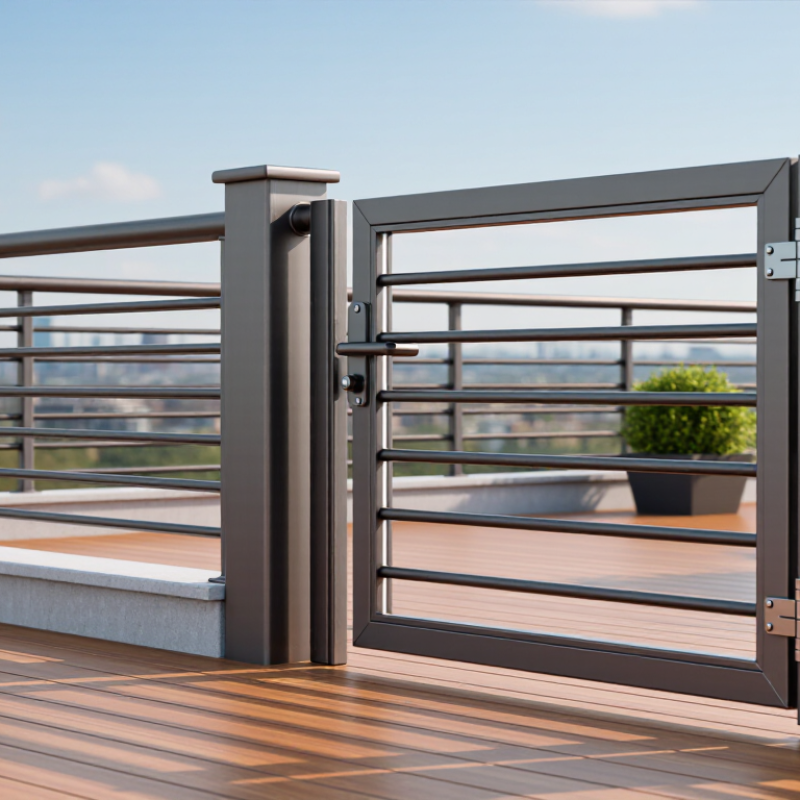
Treat a railing door as a controlled opening in a guardrail, not merely a matching panel. Define who will pass through it and what hazard lies beyond. A roof access point used occasionally by technicians may need a compact, self-closing gate. A busy loading platform has different demands: carts need clearance, hinges face repeated impacts, and workers may operate the latch with gloves. Fit matters.
The installation setting changes material and hardware choices. Coastal air can corrode ordinary steel; rain can make a threshold slippery. On stairs, check that the door’s swing does not obstruct a landing or collide with handrails. For an elevated work area, confirm the gate closes reliably after each passage. These details sound small. They are not.
The risk deserves attention. OSHA’s 2022 construction fatality data recorded 395 fatal falls among 1,069 construction deaths. The Bureau of Labor Statistics reported 885 fatal work injuries from falls, slips, and trips across all industries in 2023. These figures do not predict the performance of one gate, but they show why the opening deserves careful assessment. Record the opening width, traffic frequency, exposure to weather, and required access before specifying hardware. Then check the installed gate in real use; a latch that works neatly on paper may be awkward with wet gloves.
| Purpose | Typical Installation Setting | Suitable Door Type | Material Considerations | Key Selection Checks |
|---|---|---|---|---|
| Control access to a deck or patio | Outdoor residential deck, porch, or raised patio | Hinged gate that matches the adjoining railing | Coated steel, aluminum, or appropriately treated wood; outdoor finishes should suit local weather exposure | Check the clear opening, hinge support, latch operation, and whether the gate swings clear of steps or walking paths |
| Secure a pool-area entry | Residential swimming pool enclosure | Self-closing, self-latching gate where required by local pool-safety rules | Corrosion-resistant metal or other durable material suitable for regular moisture and pool chemicals | Confirm gate height, latch position, opening direction, gaps, and enclosure requirements with the local authority |
| Provide controlled access to a balcony | Apartment or house balcony | Purpose-designed hinged access gate integrated with the balcony railing | Materials and fixings should be compatible with the existing railing and suitable for exterior exposure | Have the railing and attachment points assessed; preserve required guard height and avoid creating climbable openings |
| Restrict access to a stair landing | Top or bottom of an indoor or outdoor stairway | Hinged gate positioned to control access without obstructing the stair route | Indoor finishes may prioritize appearance; exterior installations need weather-resistant materials and hardware | Check swing clearance, landing space, secure mounting, and whether the gate could create a fall or trip hazard |
| Manage entry to a commercial or shared space | Shared terrace, rooftop area, or controlled-access walkway | Heavy-duty hinged gate or access gate specified for the site's use | Choose durable construction and corrosion-resistant hardware based on traffic, exposure, and maintenance needs | Confirm expected use, locking or access-control needs, accessible route requirements, and structural fixing details |
| Close a gap in an existing railing system | Retrofit project on a deck, balcony, or platform | Custom-sized gate compatible with the existing railing profile | Match material and finish where practical; avoid incompatible metals or fixings that may accelerate corrosion | Measure the opening at multiple points and check post condition, alignment, hinge space, and latch reach |